
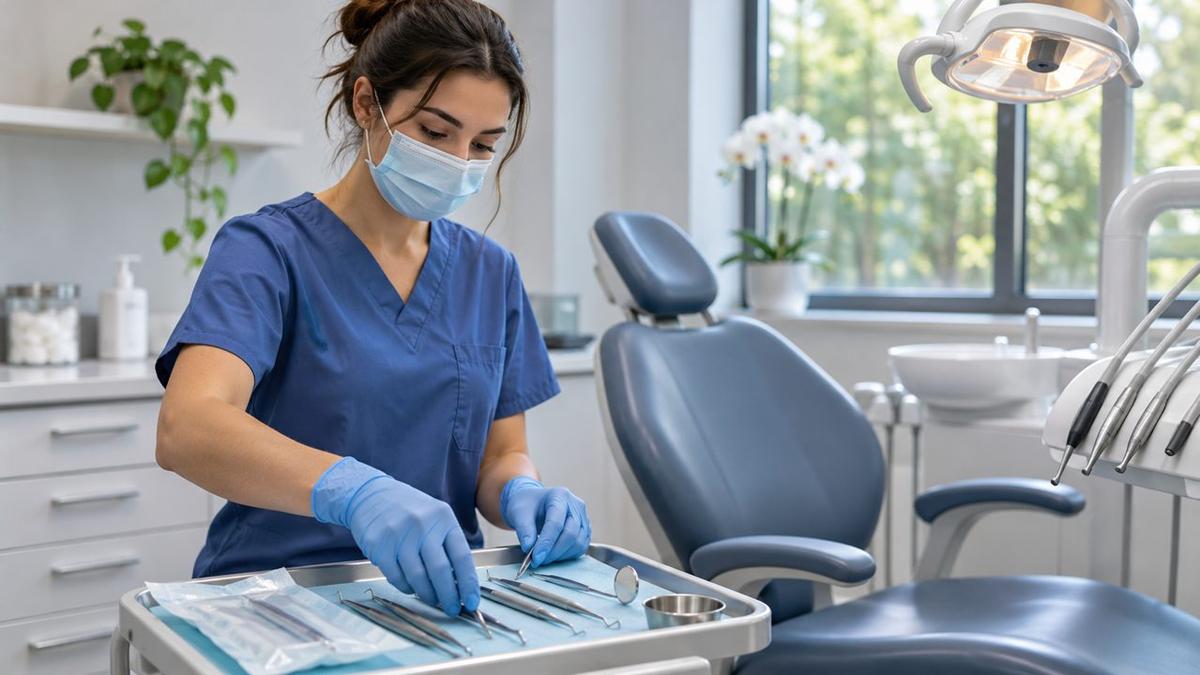
A dental assistant salary in the United States sits close to the middle of the healthcare support ladder: the Bureau of Labor Statistics (BLS) puts the median at $48,070 a year, or $23.11 an hour, for May 2025. That is the latest official pay snapshot available in late 2026, and it comes with a decent hiring picture too. Below we break down what dental assistants earn at the low and high ends, which employers pay more, how DANB certification fits in, and whether the job is a smart first step into dentistry.
Dental Assistant Salary in 2026: The Official Numbers
The BLS Occupational Outlook Handbook, updated on October 29, 2026, reports these figures for dental assistants. All wage numbers cover May 2025, the most recent reference period of the federal wage survey.
- Median annual wage: $48,070 ($23.11 per hour). Half of dental assistants earned more, half earned less.
- Lowest 10 percent: under $37,130 a year, or about $17.85 an hour.
- Highest 10 percent: over $62,250 a year, or about $29.93 an hour.
- Jobs in 2025: 388,600.
The gap between the bottom and top tenth is roughly $25,000 a year. Most of that spread comes from experience, the duties a state allows an assistant to perform, and local cost of living. An assistant whose state credentials cover tasks like x-rays or coronal polishing can lift routine work off the dentist, and practices tend to pay for that flexibility.
The median is a useful anchor, but treat it as a starting point for negotiation rather than a ceiling. Offers in large metro areas often land above it, while rural practices tend to pay closer to the lower band.
Where dental assistants work and what each setting pays
Almost the whole profession works in one place: private dental offices. According to the BLS, 91 percent of dental assistants were employed by offices of dentists, with outpatient care centers, physicians' offices and government each accounting for about 2 percent. Pay differs modestly by setting.
| Employer type | Median annual wage | Share of jobs |
|---|---|---|
| Government (excluding state and local education and hospitals) | $55,270 | 2% |
| Outpatient care centers | $49,090 | 2% |
| Offices of dentists | $48,000 | 91% |
| Offices of physicians | $47,310 | 2% |
Government roles, which include federal facilities such as military and veterans' clinics, pay the most, about $7,000 above the typical private office. They are also the scarcest. For most job seekers the realistic question is not which sector to pick but which practice: a busy specialty office in oral surgery or orthodontics may pay more than a small general practice down the street.
How Dental Assistant Pay Compares With Similar Jobs
Dental assisting is one of several healthcare support jobs you can enter with a short certificate program. The table below puts it next to related roles, using BLS medians for May 2025 and job growth projections for 2025 to 2035.
| Occupation | Median annual pay | Typical entry education | Projected growth 2025–35 |
|---|---|---|---|
| Dental assistants | $48,070 | Postsecondary nondegree award | 7% |
| Dental hygienists | $98,100 | Associate's degree | 8% |
| Pharmacy technicians | $45,750 | High school diploma or equivalent | 6% |
| Medical assistants | $45,690 | Postsecondary nondegree award | 13% |
Dental assistants out-earn medical assistants and pharmacy technicians at the median by a few hundred to a few thousand dollars. The bigger story is the next rung up. Dental hygienists earn roughly twice as much. If you like clinical work and plan to stay in dentistry, time spent chairside lets you test that commitment and get comfortable with patients long before you ever fill out a hygiene program application.
Job Outlook: Steady Demand Through 2035
The BLS projects dental assistant employment to grow 7 percent from 2025 to 2035, which it classifies as much faster than average. That works out to 28,800 additional jobs over the decade. More important for job seekers is turnover: the agency expects about 53,000 openings a year on average, most of them created when people retire, switch careers or move into hygiene.
Three forces sit behind that demand, according to the BLS:
- Prevention gets more attention. Research tying oral health to overall health keeps pushing patients toward routine cleanings and checkups.
- Dentists delegate more. Practices hire assistants to take over routine tasks so the dentist can see more patients, and growing practices need more hands.
- An aging population keeps its teeth. Older adults tend to have more oral health problems, and today's seniors retain more natural teeth than earlier generations, so they need more care.
Roughly 53,000 yearly openings for a workforce under 400,000 means a lot of churn. For you that cuts both ways: openings are plentiful, but so is turnover, so ask how long the current chairside team has stayed before you accept an offer.
Training, Licensing and DANB Certification
The typical entry route is a postsecondary nondegree award. Many programs take about a year and end in a certificate or diploma; two-year associate degree programs exist but are less common. Most are run by community colleges and mix classroom work, lab practice and supervised clinical hours.
Rules on licensing vary sharply by state. The BLS notes that states typically do not require a license for entry-level dental assistants, but some do require licensing, registration or certification to start work or to perform specific tasks such as radiography or infection control. Your state Board of Dental Examiners is the final word on what you may do without extra credentials.
What the DANB CDA exam involves
The Dental Assisting National Board (DANB) offers the Certified Dental Assistant (CDA) credential. According to DANB, the full CDA exam combines three component exams: Radiation Health and Safety (RHS), Infection Control (ICE) and General Chairside Assisting (GC). Taken together, the exam runs 195 minutes and contains 245 questions.
RHS and ICE can be taken early. The GC component is gated by one of three eligibility pathways, and each one also requires current hands-on CPR, BLS or ACLS from a DANB-accepted provider:
- Pathway I: graduation from a dental assisting or dental hygiene program accredited by the Commission on Dental Accreditation (CODA).
- Pathway II: a high school diploma or equivalent plus at least 3,500 hours of approved work experience.
- Pathway III: former CDA status, or certain dental degrees or postgraduate programs.
Exam fees change from time to time, so check the current price on the DANB website before you budget for it.
Worked Example: What a Raise to the Median Is Worth
Suppose you start at the 10th percentile hourly rate of $17.85 and work a standard full-time schedule of 40 hours a week for 52 weeks, or 2,080 hours.
- Starting gross pay: $17.85 × 2,080 = $37,128 a year, in line with the BLS 10th percentile of $37,130.
- At the median: $23.11 × 2,080 = $48,068.80, matching the $48,070 annual median.
- Difference: $5.26 an hour, or $10,940.80 a year before tax.
Now consider the on-the-job route to the GC exam. If you qualify through Pathway II, 3,500 hours at 40 hours a week takes 87.5 weeks, about 1 year and 8 months of full-time work. In other words, an assistant hired straight out of high school could reach GC eligibility in under two years, while a graduate of a CODA-accredited program can sit for it right away. Whether the credential lifts your pay depends on your state and employer, so ask before you pay for the exam; but in states that allow expanded duties only for certified assistants, it is often the cheapest path toward that $10,000 jump.
How to Land a Better-Paying Dental Assistant Job
- Know your state's duty rules. If radiography or coronal polishing requires a credential where you live, earning it makes you more useful and harder to replace.
- Look beyond general practices. Federal clinics posted the highest median by setting, and specialty offices often need assistants with specific procedure experience.
- Quote the median in negotiations. Naming the BLS figure of $23.11 an hour gives you a neutral reference point that is hard to dismiss.
- Keep your resume clinical. List procedures, software and infection control tasks you handled, not just generic duties. A clean, hosted version from the ScrollJob resume builder is quick to send.
- Search widely. Browse current openings on ScrollJob jobs and compare offers with the US median salary for full-time workers.
Dental Assistant Salary FAQ
How much does a dental assistant make an hour?
The BLS median was $23.11 an hour in May 2025. The lowest 10 percent earned under about $17.85, and the top 10 percent earned over about $29.93.
Do you need a license to be a dental assistant?
Not always. Many states do not license entry-level assistants, but some require licensing, registration or certification to start work or to perform tasks such as taking x-rays. Check with your state Board of Dental Examiners.
How long does dental assistant training take?
Many certificate or diploma programs take about one year. Associate degree programs usually take two years and are less common.
What is on the DANB CDA exam?
Three components: Radiation Health and Safety, Infection Control and General Chairside Assisting. The combined exam takes 195 minutes and has 245 questions.
Is dental assisting a good step toward becoming a hygienist?
It can be. Hygienists earned a median of $98,100 in May 2025 and need an associate degree, and chairside work lets you see the clinical side of dentistry up close before you commit to that degree.
Are dental assistant jobs in demand?
Yes. The BLS projects 7 percent growth from 2025 to 2035 and about 53,000 openings a year on average over the decade.
Conclusion
Dental assisting offers a fast entry into healthcare, a median wage of $48,070, and steady openings well into the next decade. The pay ceiling is real, around $62,000 at the top tenth, so the smartest moves are to collect the credentials your state rewards, aim for practices that value expanded duties, and keep the hygienist path in mind if you want to double your earning power later.
Sources: U.S. Bureau of Labor Statistics, Occupational Outlook Handbook (dental assistants, dental hygienists, medical assistants, pharmacy technicians; wages May 2025, projections 2025–35); O*NET OnLine national wages for dental assistants (BLS 2025 data); Dental Assisting National Board, CDA exam page.