
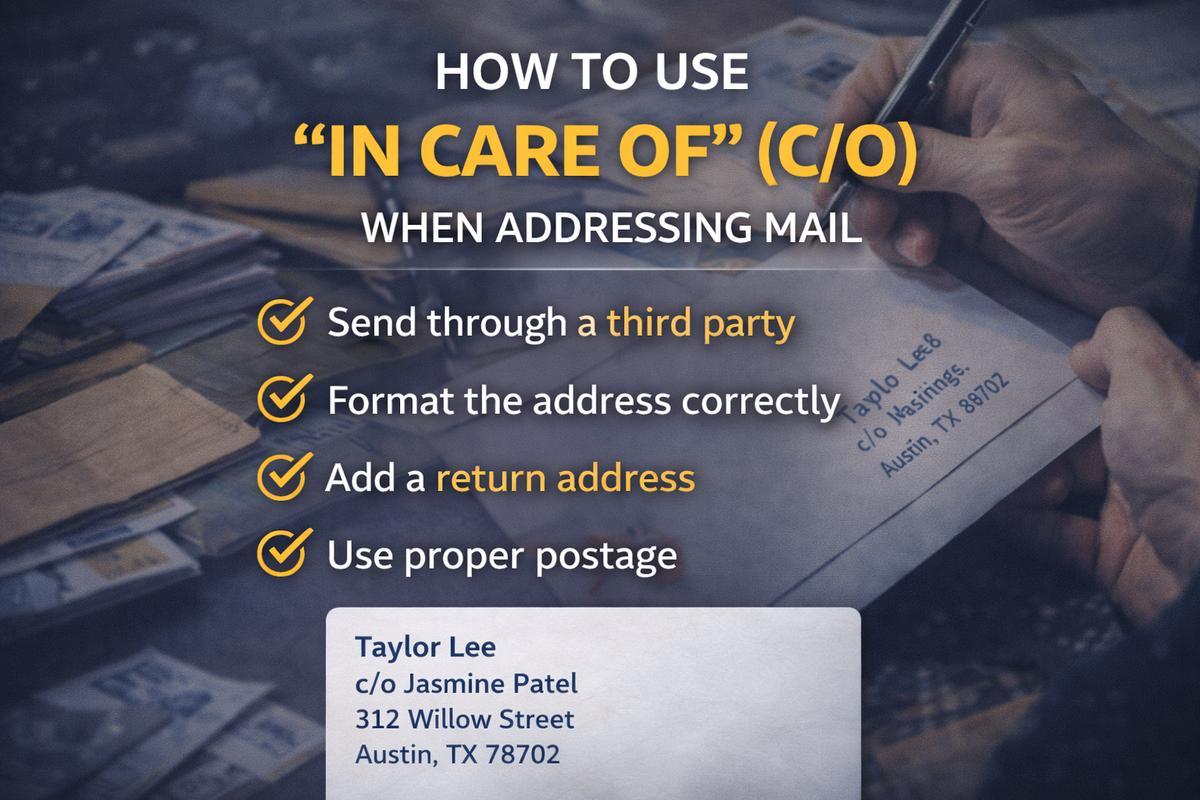
How to Use “In Care Of” (C/O) Correctly When Addressing Mail
Sending mail isn’t always as straightforward as writing a name and address. Sometimes the person you’re contacting doesn’t live at the destination permanently, doesn’t have their own mailbox, or needs their correspondence routed through someone else. In these cases, using “in care of” (c/o) ensures your letter or package reaches the right hands.
This guide explains what “c/o” means, when you should use it, and how to format an address properly to avoid delivery issues.
What Does “In Care Of” Mean?
“In care of,” abbreviated as c/o, tells the postal service that your mail should be delivered to one person or organization on behalf of the intended recipient. The individual or business listed after “c/o” accepts the mail and passes it along.
It’s a practical solution when the final recipient:
-
Doesn’t live at the address permanently
-
Is staying somewhere temporarily
-
Uses a workplace or third party for correspondence
Think of c/o as a forwarding instruction built directly into the address.
When Should You Use “C/O” in an Address?
Using “in care of” is appropriate in several common situations:
1. Sending Mail to a Workplace
If you don’t have someone’s home address, you can send mail to their employer using “c/o” before the company name.
2. Mailing to a Hotel or Temporary Stay
When someone is staying at a hotel, Airbnb, or short-term rental, “c/o” helps the front desk or host know who the mail is for.
3. Delivering to Someone Else’s Home
If the recipient is living with friends or family, listing the host after “c/o” ensures the mail is accepted and forwarded.
4. Handling Legal or Sensitive Documents
Some people prefer important mail—such as legal or financial documents—to be delivered through a trusted third party like a lawyer, assistant, or business office.
How to Format an Address Using “C/O”
Correct formatting is essential to avoid delays or lost mail. Follow these steps:
1. Verify the Full Address
Confirm the complete and accurate address of the person or organization receiving the mail, including:
-
Full name
-
Street address
-
City, state, and ZIP/postal code
2. Write the Address in the Correct Order
Always list the intended recipient first, followed by the c/o line.
Example:
Emily Johnson c/o Greenleaf Studios 1000 Oak Avenue Springfield, IL 62704
3. Include a Return Address
Add your return address in the top-left corner or on the back flap. This ensures the mail can be returned if delivery fails.
4. Use Proper Postage
Check that your envelope or package has sufficient postage based on its size and weight. When in doubt, a post office clerk can help.
5. Double-Check Before Sending
Review names, spelling, and numbers one last time. Small errors can cause big delivery problems.
Examples of “C/O” Addresses
Sending to a Workplace
Emily Johnson c/o Greenleaf Studios 1000 Oak Avenue Springfield, IL 62704
Sending to a Temporary Residence
Chris Adams c/o Sarah Wilson 45 Park Lane Seattle, WA 98101
Frequently Asked Questions
What does “c/o” stand for?
“C/O” stands for “in care of.” It indicates that someone else is receiving the mail and will pass it to the intended recipient.
When should I use “in care of”?
Use it whenever you’re sending mail through a third party—such as a company, hotel, or host—especially if the recipient doesn’t have a permanent address at that location.
How do I correctly write a “c/o” address?
Write the recipient’s name first, then add a line with “c/o” followed by the name of the person or organization receiving the mail.
Example:
Taylor Lee c/o Jasmine Patel 312 Willow Street Austin, TX 78702
Is a return address required when using “c/o”?
Yes. A return address is always recommended so your mail can be sent back if it can’t be delivered.
Final Thoughts
Using “in care of” is a simple but powerful way to make sure your mail reaches the right person—even when their address situation isn’t straightforward. Whether you’re sending professional correspondence, personal letters, or important documents, correct formatting helps avoid delays and confusion.


