
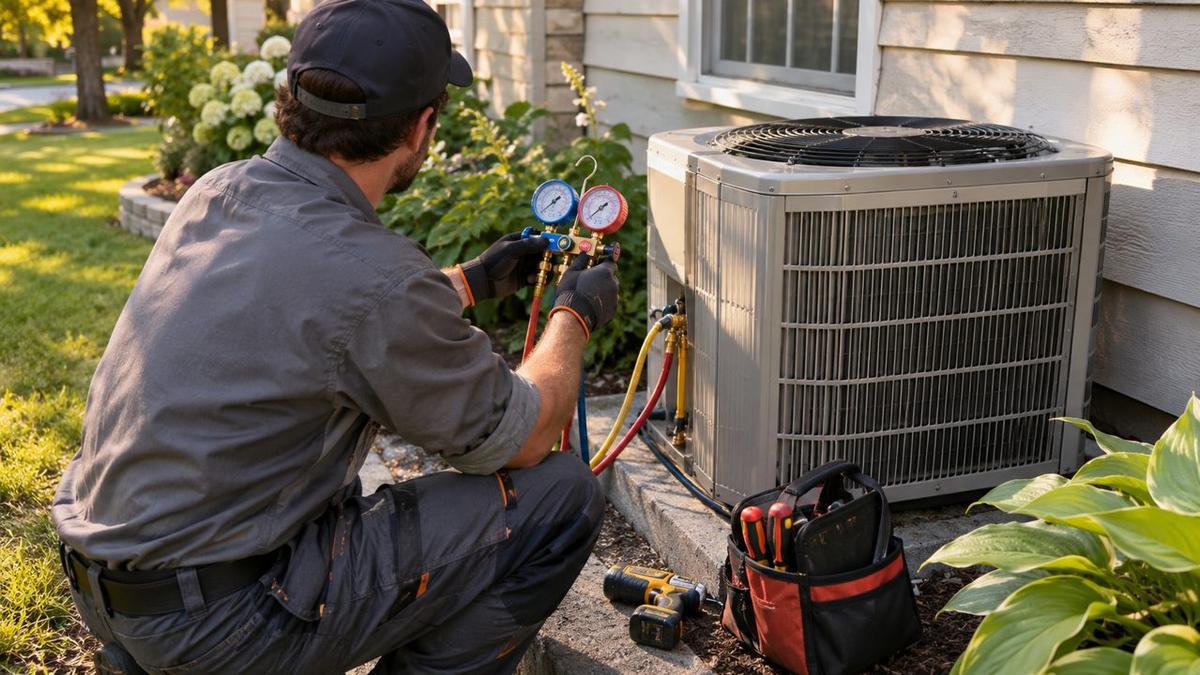
An HVAC technician in the United States earned a median of $61,010 a year in May 2025, or $29.33 an hour, according to the Bureau of Labor Statistics (BLS). That is the newest federal wage survey available, and it hides a wide spread: the same trade pays about $20,000 more at the median in Massachusetts than in Florida. This guide covers what the job pays, which credentials are legally required, how a recent federal refrigerant rule affects daily work, and how to get hired.
Where HVAC Technicians Work
BLS counted about 440,900 heating, air conditioning, and refrigeration mechanic and installer jobs in 2025. Most of them sit with one type of employer. Plumbing, heating, and air-conditioning contractors account for 68% of those jobs, self-employed workers for 6%, and wholesale trade for 3%.
In practice, that means your first employer is probably a contractor, and your week will be shaped by whatever broke or needs replacing in your service area. BLS says most technicians work full time, that schedules can include evenings and weekends, and that on-call emergency work and overtime can be part of the job during peak heating and cooling seasons.
The physical side deserves a straight answer too. BLS reports that these workers have one of the highest rates of injuries and illnesses of all occupations, with electrical burns, chemical exposure, and strains from heavy equipment among the hazards. Ask any employer how they handle safety training and lifting before you accept an offer.
HVAC Technician Salary: What the Latest Data Shows
Nationally, the lowest-paid 10% of workers earned less than $40,050 in May 2025 and the highest-paid 10% earned more than $95,210. For context on how the trade compares with other work, see our guide to US median salaries.
Location moves those numbers more than most people expect. The table below compares the national figure with six states. It is a selection, not a ranking of every state, and the figures are not adjusted for cost of living.
| Area | 10th percentile | Median | 90th percentile | Median vs. US |
|---|---|---|---|---|
| Massachusetts | $50,820 | $77,300 | $102,410 | +$16,290 |
| New York | $48,560 | $74,430 | $100,680 | +$13,420 |
| California | $46,950 | $72,560 | $109,060 | +$11,550 |
| United States | $40,050 | $61,010 | $95,210 | n/a |
| Arizona | $37,950 | $59,400 | $80,160 | -$1,610 |
| Texas | $38,100 | $57,760 | $81,860 | -$3,250 |
| Florida | $38,370 | $56,670 | $78,210 | -$4,340 |
Two patterns stand out. Hot states with heavy cooling demand do not automatically pay more. Arizona, Texas, and Florida all sit below the national median. And among these states, the top of the range stretches furthest in California, where the 90th percentile passes $109,000.
Employer type matters as well. BLS puts the May 2025 median at $71,190 in wholesale trade and $60,030 at plumbing, heating, and air-conditioning contractors, an $11,160 gap. Wholesale trade is a small slice of the field, though, so treat that premium as a niche opportunity rather than a typical outcome.
The 10th percentile describes the lower end of the whole workforce and is not a starting-salary figure, so ask for the actual pay scale when you interview.
Worked Example: What a Busy Summer Adds to a Texas Paycheck
Federal law requires covered, non-exempt employees to receive at least one and a half times their regular rate for hours beyond 40 in a workweek. Here is what that does for a hypothetical technician paid the Texas median of $27.77 an hour. The 12-week season and the 50-hour weeks are our assumptions, chosen for illustration, not survey data.
- Overtime rate: $27.77 x 1.5 = $41.655 an hour
- Normal 40-hour week: 40 x $27.77 = $1,110.80
- Peak 50-hour week: $1,110.80 + (10 x $41.655) = $1,527.35
- Overtime across 12 weeks: 120 hours x $41.655 = $4,998.60
- Base pay for 2,080 hours: $57,761.60
- Total with overtime: $62,760.20
In this scenario, one hard summer lifts a below-average Texas wage about $1,750 above the national median. The lesson for your job search is simple: compare offers on expected annual earnings. Ask how many overtime hours the last crew actually logged.
Training, Certification, and Licensing
Training routes
BLS says the typical entry point is a postsecondary nondegree award, although some people start with less education. Training programs usually run from 6 months to 2 years and end in a certificate or associate degree. Others train through an apprenticeship, which usually lasts several years and combines paid work with technical instruction. Either way, expect long-term on-the-job training after you are hired.
EPA Section 608 certification
This is the one credential you cannot skip. The Environmental Protection Agency requires certification for technicians who maintain, service, repair, or dispose of equipment that could release refrigerants. Apprentices are exempt only while closely and continually supervised by a certified technician. Credentials do not expire, so there is no renewal cycle to track. EPA also restricts refrigerant sales, and certification is what lets a technician buy refrigerant for stationary equipment.
| Type | Equipment covered |
|---|---|
| Type I | Small appliances |
| Type II | High-pressure and very high-pressure appliances, excluding small appliances and motor vehicle air conditioners |
| Type III | Low-pressure appliances |
| Universal | All types of equipment |
State and local licenses
BLS notes that some states and localities require HVAC technicians to be licensed, and the rules vary, so check your state board before you relocate. California shows how demanding the contractor level can be. To qualify for a C-20 warm-air heating, ventilating, and air-conditioning contractor license, the qualifying person must be at least 18 and have at least four full years of experience at journey level or as a foreman, supervisor, or contractor, within the ten years before applying. The state also requires active C-20 contractors to carry workers' compensation whether or not they have employees.
The Refrigerant Rule Every New Tech Should Understand
A federal rule published May 26, 2026, at 91 FR 31284 took effect on July 27, 2026, and it changes what you are likely to find on a job site. The background: a 2023 rule restricted installing new residential and light commercial systems that use refrigerants above a global warming potential limit of 700, starting January 1, 2025. A later interim rule pushed the date to January 1, 2026, for equipment made or imported before 2025.
The 2026 rule removes that installation deadline where all specified components were domestically manufactured or imported before January 1, 2025. EPA said this allows remaining R-410A inventory to be installed. It also acknowledged supply problems with R-454B, a compliant replacement, including trouble getting it in service cylinders and scarcity in some regions.
For a new hire, the takeaway is practical. You should expect to work with older R-410A equipment and newer R-454B equipment during the same stretch of your career, so ask training programs and employers how they cover both. Federal refrigerant rules do change, so confirm current requirements with EPA.
Job Outlook Through 2035
BLS projects employment to grow 11% from 2025 to 2035, much faster than the average for all occupations. That is 48,200 added jobs, alongside about 40,600 openings a year on average.
Those two numbers tell different stories. Spread evenly, the net growth works out to only about 4,820 jobs a year, so the large majority of annual openings come from replacing people who change occupations or leave the labor force. Demand for newcomers therefore depends less on a building boom than on experienced workers moving on. BLS also expects commercial construction, including data centers, and residential construction to drive growth, while more sophisticated climate-control systems should add work. That outlook is worth weighing against the broader slowdown in US hiring.
How to Get Your First HVAC Job
- Pick a route. Compare a 6-month to 2-year program against a paid apprenticeship in your area.
- Earn Section 608 certification. BLS says it usually comes through a training program.
- Check licensing rules in your state and city before you sign on with an employer.
- Build a short skills-first resume. Our free resume builder makes that quick.
- Search current job listings, and ask each employer about tools, vehicles, on-call rotation, and overtime history.
HVAC Technician FAQ
How much does an HVAC technician make per hour?
The national median was $29.33 an hour in May 2025. Among the states in our table, the median ranged from $27.24 in Florida to $37.16 in Massachusetts.
How long does it take to become an HVAC technician?
Training programs usually take 6 months to 2 years, and apprenticeships usually last several years. BLS also describes long-term on-the-job training after hiring.
Do you need a degree?
No bachelor's degree is typical. BLS lists a postsecondary nondegree award as the usual entry-level education, and some people enter with less.
Does EPA 608 certification expire?
No. EPA states that Section 608 Technician Certification credentials do not expire.
Can an apprentice handle refrigerant without certification?
Only under close and continual supervision by a certified technician, according to EPA.
Is HVAC a good career for the next decade?
The projections are strong, with 11% growth and about 40,600 openings a year through 2035. Weigh that against the trade's high injury rate and irregular peak-season hours.
Conclusion
This trade offers a path to median wages from the mid-$50,000s to the high-$70,000s in the states we compared, without a four-year degree. The best moves are to earn Section 608 certification early, learn both older and newer refrigerant equipment, and judge each offer on annual earnings rather than the hourly rate alone.
Sources: US Bureau of Labor Statistics, Occupational Outlook Handbook (May 2025 wages, 2025–35 projections); O*NET OnLine state wages (BLS 2025 wage data); US Environmental Protection Agency, Section 608 pages; Federal Register, 91 FR 31284 (May 26, 2026); California Contractors State License Board; 29 U.S.C. 207.