A dental hygienist career is one of the few routes into a pay band close to six figures that usually starts with an associate's degree rather than a four-year diploma. According to the Bureau of Labor Statistics (BLS), the median dental hygienist earned $98,100 a year, or $47.16 an hour, in May 2025. That is almost twice the $50,980 median for all US workers in the same month. This guide covers what the job involves, how pay changes from state to state, what licensing takes, and how the work week affects what you actually take home.
What a Dental Hygienist Actually Does
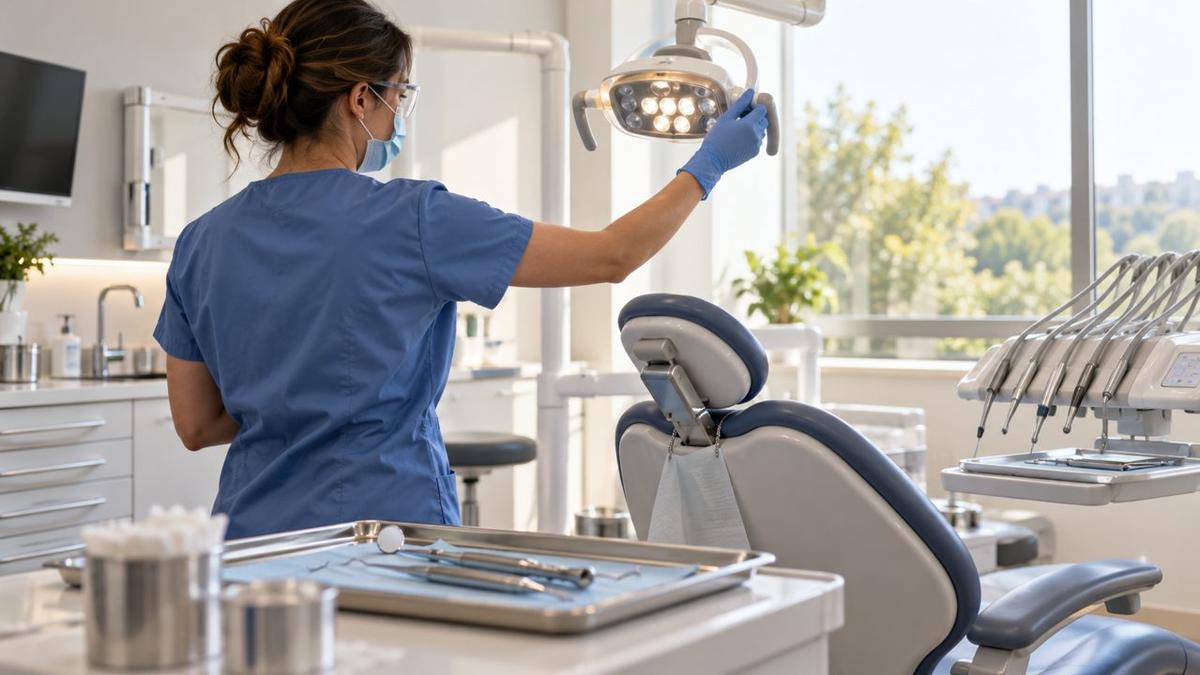
Hygienists handle most of the preventive care in a dental practice. The duties the BLS lists in its Occupational Outlook Handbook include removing tartar, stains and plaque, applying sealants and fluoride, taking dental x-rays, assessing oral health and reporting findings to the dentist, documenting care and treatment plans, and teaching patients how to brush and floss properly.
Almost everyone in the field works in a dental office. In the BLS data, offices of dentists employ 94% of hygienists, and offices of physicians and government each account for about 1%. In practice, that means your day is shaped by the dentist who employs you: how long appointments are, which instruments you have, and how many patients you see before lunch.
The handbook names six qualities that matter: critical thinking, communication, attention to detail, dexterity, interpersonal skills and problem-solving. Dexterity is easy to overlook when you are reading course catalogs. The work means hours of fine instrument control inside a patient's mouth, so steady hands and good posture habits are worth building from the first semester.
Dental Hygienist Salary by State in 2025
The national median hides big regional differences. The table below uses BLS wage estimates for May 2025, as shown on O*NET OnLine, the Department of Labor's occupation database. Annual figures assume full-time hours. These are wages only, so a lower-paying state is not necessarily a worse place to build a career once you factor in rent and other living costs.
| Area | Median hourly wage | Median annual wage | Lowest-paid 10% earn up to |
|---|---|---|---|
| Washington | $63.06 | $131,160 | $107,090 |
| California | $60.06 | $124,930 | $102,090 |
| New York | $51.03 | $106,130 | $77,680 |
| Texas | $47.71 | $99,240 | $71,530 |
| United States | $47.16 | $98,100 | $74,880 |
| Florida | $44.22 | $91,980 | $75,960 |
| Ohio | $42.78 | $88,990 | $76,260 |
Two points stand out. First, the West Coast is in a different league: in Washington, even the lowest-paid tenth of hygienists earn up to $107,090, which is above the national median. Second, Texas sits slightly above the national median even though it pays less than the coasts. Nationally, the top 10% of hygienists earned more than $126,050 in May 2025.
The employer type matters less than the location. In the May 2025 figures, hygienists in dental offices had a median of $98,280, compared with $91,160 in physicians' offices and $80,830 in government jobs. A lower cash wage can still be the better deal if the benefits package is stronger, so compare total compensation, not just the hourly rate.
How Hygienist Pay Compares With Similar Healthcare Jobs
A useful way to judge any career is to compare it with the jobs you could have trained for instead. The BLS publishes May 2025 medians for related occupations:
- Dental assistants: $48,070
- Medical assistants: $45,690
- Radiologic and MRI technologists: $81,390
- Registered nurses: $97,550
- Radiation therapists: $105,310
- Physician assistants: $135,880
- Dentists: $176,110
The comparison with dental assistants is the one that matters most for career changers. Both jobs are done chairside in the same office, yet the hygienist median is roughly double. The biggest visible difference is licensing: every state requires hygienists to hold a license backed by an accredited degree and exams. If you already work as an assistant, moving into a hygiene program is one of the clearest pay upgrades available in dentistry.
Education and Licensing Requirements
The degree
Most hygienists hold an associate's degree in dental hygiene. The BLS notes that programs typically take about three years, which is longer than many associate's degrees, because they combine classroom study, lab work and supervised clinical hours. Coursework covers anatomy, medical ethics and periodontics, the study of gum disease. Bachelor's programs exist and can help if you later want to teach, do research or move into public health, but they are not needed for clinical work.
The license
Every state requires a license, and the details vary. Most states ask for a degree from an accredited dental hygiene program plus passing written and clinical exams, and you must complete continuing education to keep the license. Many employers also want current CPR certification.
The written part is usually the National Board Dental Hygiene Examination (NBDHE), governed by the Joint Commission on National Dental Examinations (JCNDE). Candidates take it at Pearson VUE test centers after the JCNDE confirms their eligibility, which usually means proof of graduation from an accredited program. The JCNDE lists a test time of nine hours and says results become available three to four weeks after the exam. Because licensing requirements vary by state, check with the dental board in the state where you plan to work about which clinical exam it accepts before you book anything.
Job Outlook Through 2035
The BLS projects employment of dental hygienists to grow 8% between 2025 and 2035, from about 225,300 jobs to 243,200, an increase of 17,900 positions. The average for all occupations over the same decade is 3%. The agency expects about 15,000 openings a year, most of them created when hygienists retire or leave for other work rather than by new positions.
The reasons are mostly about demographics. An aging population needs more dental care, people keep their natural teeth longer than earlier generations did, and research linking oral health to overall health supports preventive visits. The BLS also points to state laws that increasingly let hygienists work at the top of their training. For job seekers, that combination means steady demand, but not a shortage in every town. Check local postings before you commit to a program.
Worked Example: Part-Time Versus Full-Time Earnings
Annual medians assume a full-time schedule, but part-time work is common in this field. The BLS notes that dentists often hire hygienists for only a few days a week, so some hygienists work for more than one practice. Here is what that means for a hygienist paid the Texas median of $47.71 an hour.
- Full-time, one office: 40 hours × 52 weeks = 2,080 hours. 2,080 × $47.71 = about $99,237 a year before tax, which matches the published $99,240 Texas median.
- Three days at one office: 3 days × 8 hours = 24 hours a week. 24 × $47.71 = $1,145.04 a week. Over 50 working weeks, that comes to $57,252.
- Three days plus two days at a second office: adding 16 hours at the same rate brings in $763.36 a week, or $38,168 over 50 weeks, for a combined $95,420.
The takeaway is that the headline salary depends on filling the week. Two part-time jobs can bring you close to the full-time figure, but you may have to handle two sets of benefits or none at all. When you compare offers, ask how many hours are guaranteed, whether paid time off is prorated, and who pays for continuing education and malpractice coverage.
How to Land Your First Hygiene Job
Start building your network during clinical rotations. The dentists and office managers you meet as a student are often the first people who hire you, or they know who is hiring. Next, prepare a resume that leads with your license status, clinical hours, the patient populations you have treated and certifications such as CPR. A free tool such as the ScrollJob resume builder makes it quick to produce a clean version, and you can also host your resume online so practices can view it from a link.
Expect employers to confirm your license and work history. Our guide to employment verification in the US explains what a background check actually shows. When you are ready, browse current openings on the ScrollJob jobs board and filter by your area.
Dental Hygienist FAQ
How much does a dental hygienist make in the US?
The median was $98,100 a year, or $47.16 an hour, in May 2025, according to the BLS. The lowest-paid 10% earned under $74,880 and the top 10% earned more than $126,050.
Which state pays dental hygienists the most?
Of the states compared in this guide, Washington had the highest median at $131,160 in May 2025, followed by California at $124,930.
How long does it take to become a dental hygienist?
Most people complete an associate's degree in dental hygiene, which the BLS says typically takes about three years, and then pass written and clinical exams for a state license.
Do dental hygienists need a license in every state?
Yes. All states require a license. Requirements differ, but they usually include an accredited degree, written and clinical exams and ongoing continuing education.
Is dental hygiene a growing field?
The BLS projects 8% employment growth from 2025 to 2035, compared with 3% for all occupations, with about 15,000 openings a year.
Can I work part time as a dental hygienist?
Yes. Part-time schedules are common, and some hygienists split their week between two or more practices to reach full-time hours.
Conclusion
A dental hygienist career offers a rare mix: about three years of training, a protected license, a national median near $100,000 and growth well above the average for all occupations. The catch is that pay depends heavily on where you work and how many hours you can secure, as the gap between Washington and Ohio and the part-time math above both show. Research your state board's licensing rules and local wages before you enroll. Then treat your clinical rotations as your first job interview.
Sources: U.S. Bureau of Labor Statistics, Occupational Outlook Handbook, Dental Hygienists (May 2025 wages, 2025–2035 projections); BLS Occupational Employment and Wage Statistics, May 2025 state estimates via O*NET OnLine; Joint Commission on National Dental Examinations, NBDHE information page.