
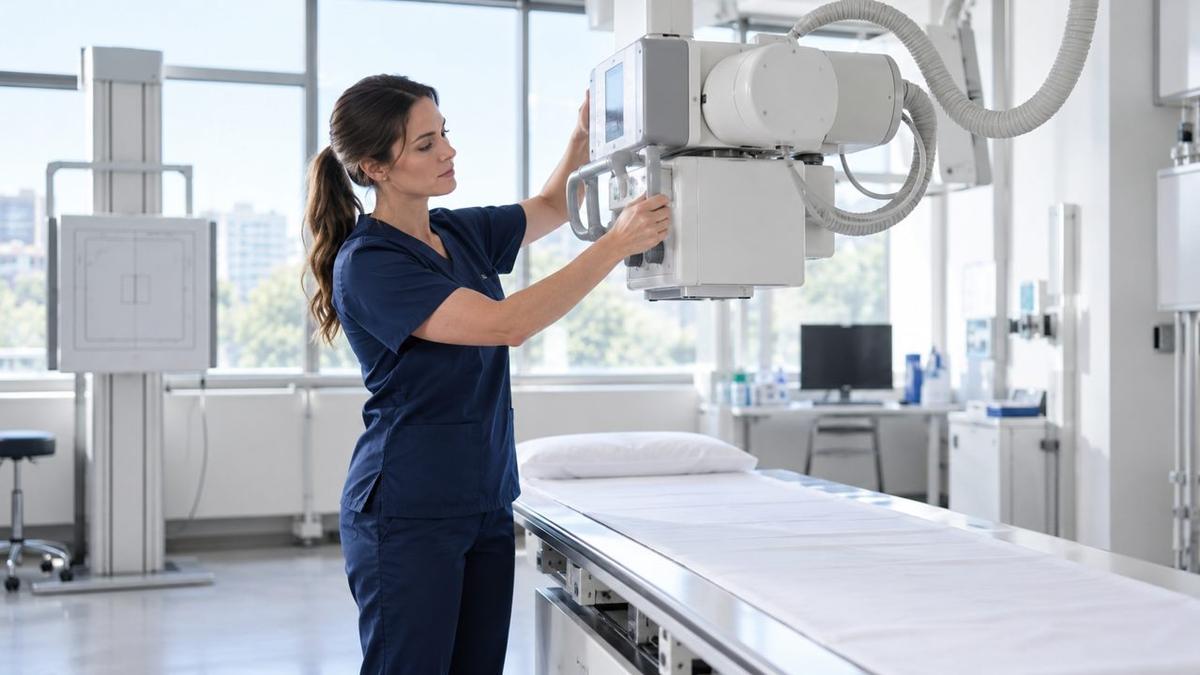
A radiologic technologist salary in the United States sits well above the typical paycheck, and the route into the job is shorter than most people expect: an associate's degree, clinical training and a certification exam. The latest federal figures, covering May 2025, put the median annual wage for radiologic technologists and technicians at $80,110, while technologists who move into magnetic resonance imaging earn a median of $95,480. This guide walks through what the role pays, where the money is highest, how demand is expected to change through 2035 and what it takes to keep your credentials active once you are working.
What a Radiologic Technologist Does Day to Day
Radiologic technologists perform diagnostic imaging exams. In practice that means positioning patients, operating x-ray and related equipment, protecting patients and staff from unnecessary radiation, and producing images a physician can actually read. MRI technologists do similar work on magnetic resonance scanners, which use magnetic fields rather than ionizing radiation.
Most of these jobs are in hospitals. According to the Bureau of Labor Statistics, about 234,200 people worked as radiologic technologists and technicians in 2025, and roughly 60% of them were employed by hospitals. Another 43,900 people held MRI technologist jobs, with about 61% in hospitals. Because imaging is often needed in emergencies, the BLS notes that some technologists work evenings, weekends or overnight, although most work full time.
The job rewards people who stay calm with anxious patients, follow protocols precisely and are comfortable on their feet for long stretches. It also suits career changers who want a clinical role without spending four or more years in school.
Radiologic Technologist Salary in 2026: What the Federal Data Shows
The most recent wage figures from the BLS Occupational Outlook Handbook, last updated in August 2026, describe pay in May 2025. They are the best official snapshot available for anyone weighing the career this year.
- Radiologic technologists and technicians: median of $80,110 a year. The lowest 10% earned less than $55,980, and the top 10% earned more than $118,660.
- MRI technologists: median of $95,480 a year. The lowest 10% earned less than $68,890, and the top 10% earned more than $127,670.
- Both groups combined: median of $81,390 a year, or $39.13 an hour.
For context, the BLS reports that the median annual wage for all occupations was $50,980 in May 2025, and the median for healthcare practitioners and technical occupations as a whole was $86,530. Imaging technologists therefore earn far more than the typical American worker while needing much less schooling than many other clinical professions.
Pay by type of employer
Where you work matters almost as much as what you do. The table below shows BLS median annual wages by industry for May 2025.
| Industry | Radiologic technologists and technicians | MRI technologists |
|---|---|---|
| Federal government, excluding postal service | $97,490 | Not listed |
| Outpatient care centers | $84,720 | $140,390 |
| Hospitals; state, local and private | $80,650 | $95,920 |
| Medical and diagnostic laboratories | $78,400 | $93,540 |
| Offices of physicians | $74,540 | $93,880 |
Two patterns stand out. Federal employers pay radiologic technologists the most of any listed industry, and outpatient care centers report by far the highest median for MRI technologists. Physician offices pay the least for radiography, so a tech choosing between a clinic job and a hospital or federal role should compare offers carefully.
How Imaging Careers Compare With Other Associate-Degree Health Jobs
Radiography is one of several clinical careers that typically start with an associate's degree. The BLS lists the following 2025 median pay figures and 2025 to 2035 growth projections for related occupations, all with the same entry-level education. Radiography pays the least of the four, but its projected growth is second only to respiratory therapy.
| Occupation | Typical entry-level education | 2025 median pay | Projected job growth, 2025 to 2035 |
|---|---|---|---|
| Radiation therapists | Associate's degree | $105,310 | 3% |
| Nuclear medicine technologists | Associate's degree | $101,370 | 4% |
| Respiratory therapists | Associate's degree | $82,280 | 9% |
| Radiologic and MRI technologists | Associate's degree | $81,390 | 5% |
Radiography often works as a starting point rather than a ceiling. Many technologists use their first credential and a few years of clinical experience as a springboard into MRI or other advanced modalities, where pay is higher. If you are comparing allied-health paths, our dental hygienist career guide covers another associate-degree role with strong pay.
Worked Example: The Value of Adding MRI
Consider a technologist earning exactly the national median for radiologic technologists and technicians, $80,110 a year. Moving to the MRI median of $95,480 adds $15,370 a year before taxes, an increase of about 19%. Spread across a standard 2,080-hour full-time year, that is a rise from roughly $38.51 an hour to about $45.90 an hour.
Now compare both figures with the all-occupation median of $50,980. A radiologic technologist at the median earns $29,130 more than the typical U.S. worker, about 57% more. An MRI technologist at the median earns $44,500 more, or about 87% more. These are medians, not guarantees, and your local market, shift and employer type will move the number in either direction. Still, the arithmetic shows how much a second imaging modality can be worth to a technologist who wants to stay in patient care.
Education, Licensing and Certification
The BLS identifies an associate's degree as the education typically required for radiologic and MRI technologists, and programs usually combine classroom study with clinical rotations. Some people enter through certificate programs after another health credential, and others earn a bachelor's degree, but the two-year route is the most common.
Credentials are where the rules vary. According to the BLS, most states require radiologic technologists to be licensed or certified, while few states require licensure for MRI technologists. Even where the state does not require it, employers typically require or prefer certified candidates. In practice, passing a national certification exam is close to mandatory for anyone who wants a full range of job offers.
Keeping your credential current
Certification is not a one-time event. According to the American Society of Radiologic Technologists, registered technologists must earn 24 continuing education credits every two years, and all of those credits must be Category A or A+. The two-year cycle, called a biennium, begins on the first day of your birth month and ends two years later on the last day of the month before your birth month. That works out to about one credit a month, which is easy to manage if you plan it rather than cramming before the deadline.
Job Outlook Through 2035
The BLS projects employment of radiologic and MRI technologists to grow 5% from 2025 to 2035, which it classifies as faster than the average for all occupations. Combined employment is expected to rise from 278,100 to 293,300, an increase of about 15,100 jobs. Within that total, radiologic technologists and technicians are projected to grow from 234,200 to 246,000, and MRI technologists from 43,900 to 47,300.
Openings will be more numerous than new positions. The BLS projects about 15,300 openings each year on average over the decade, most of them created when existing technologists retire or leave the field. Demand is tied to an aging population and to chronic conditions, falls and cancer cases that call for x-rays, CT scans or MRI scans.
That outlook contrasts with the slower hiring seen across much of the economy, which we covered in our look at the U.S. labor market in fall 2026. Healthcare imaging remains one of the steadier corners for job seekers.
How to Land Your First Imaging Job
- Choose an accredited program. Confirm that graduates are eligible for the national certification exam and for licensure in the state where you plan to work.
- Treat clinical rotations as a long interview. Hospital departments often hire students they have already watched work.
- Get certified before applying widely. Most employers screen for the credential, even in states that do not require it.
- Be flexible on shifts. Evening, weekend and overnight slots are common entry points into hospital departments.
- Plan your next modality early. Ask employers whether they support cross-training into MRI or CT.
- Keep your resume clinical and specific. List rotation sites, exam types and equipment. You can build one quickly with the ScrollJob resume builder and then browse openings on our job board.
Radiologic Technologist FAQ
How much does a radiologic technologist make in the US?
The BLS reports a median annual wage of $80,110 for radiologic technologists and technicians in May 2025. The lowest 10% earned less than $55,980, and the highest 10% earned more than $118,660.
Do MRI technologists earn more than x-ray technologists?
Yes. The May 2025 median for MRI technologists was $95,480, about $15,370 more than the median for radiologic technologists and technicians.
How long does it take to become a radiologic technologist?
The typical entry-level education is an associate's degree, and programs may combine academic study with clinical work. Most graduates then sit for a certification exam, because employers typically require or prefer certified technologists.
Is a state license required?
Most states require radiologic technologists to be licensed or certified, while few states require licensure for MRI technologists. Check your state board before enrolling in a program.
How many continuing education credits do technologists need?
Registered technologists must earn 24 Category A or A+ credits every two-year biennium, which starts on the first day of the birth month.
Is radiologic technology a growing field?
Yes. The BLS projects 5% employment growth from 2025 to 2035, faster than average, with about 15,300 openings a year.
Conclusion
Radiologic technology offers an unusual combination: a two-year entry path, a median wage of $80,110 that is far above the all-occupation median, steady demand through 2035 and a clear ladder into higher-paying modalities such as MRI. The trade-offs are irregular shifts, physical work and ongoing education requirements. If those suit you, the numbers make a strong case for the field.
Sources: U.S. Bureau of Labor Statistics, Occupational Outlook Handbook, Radiologic and MRI Technologists (pay data for May 2025, projections for 2025 to 2035, page last modified August 27, 2026); U.S. Bureau of Labor Statistics, Occupational Outlook Handbook, Healthcare Occupations (May 2025 median wages); BLS Occupational Outlook Handbook profiles for Nuclear Medicine Technologists, Radiation Therapists and Respiratory Therapists (2025 pay, 2025 to 2035 projections); American Society of Radiologic Technologists, Continuing Education FAQ.