
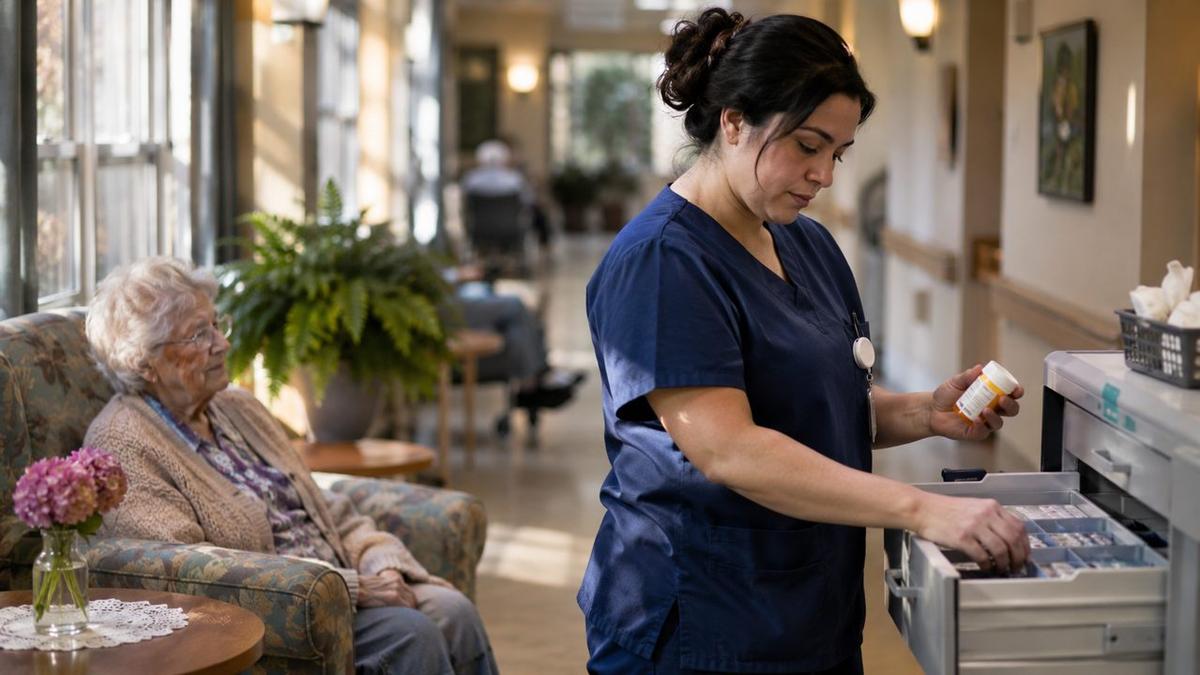
A licensed practical nurse salary in the United States now sits at a median of $64,400 a year, according to the latest Bureau of Labor Statistics figures for May 2025. That puts licensed practical and licensed vocational nurses (LPNs and LVNs) well above nursing assistants but clearly below registered nurses. On top of that, the cost of the licensing exam is about to change for the first time in a quarter century. This guide explains what LPNs earn, where the best-paid jobs are, how long training takes, and why the calendar matters if you plan to sit the NCLEX in the next few months.
Licensed Practical Nurse Salary in 2026: The Official Numbers
The BLS Occupational Outlook Handbook, last updated in September 2026, reports a median annual wage of $64,400 for LPNs and LVNs in May 2025, or $30.96 per hour. The median is the midpoint: half of all LPNs earned more, half earned less.
The spread is wide. The lowest-paid 10 percent earned less than $49,740 a year, while the top 10 percent earned more than $83,440 (both May 2025). In practice, that gap reflects differences in state, employer type, shift, and years on the job. A new graduate on day shifts in a lower-cost area usually starts toward the bottom of the range, and an experienced nurse who picks up nights and weekends tends to climb toward the top.
Employment is large and steady. BLS counts 666,900 LPN and LVN jobs in 2025 and projects 686,700 by 2035, a 3 percent increase that it describes as about as fast as the average for all occupations. More useful for job seekers is the openings figure: about 51,800 openings a year on average over the decade, most of them created when existing nurses retire, leave the workforce, or move into other roles such as registered nursing.
Where LPNs work and what each setting pays
Pay varies noticeably by setting. The figures below are BLS medians for May 2025, with the share of all LPN jobs each setting accounts for.
| Work setting | Share of LPN jobs | Median annual pay |
|---|---|---|
| Government (excluding state and local education and hospitals) | 6% | $68,970 |
| Nursing and residential care facilities | 37% | $68,020 |
| Home healthcare services | 12% | $63,580 |
| Hospitals (state, local, and private) | 16% | $61,160 |
| Offices of physicians | 11% | $59,520 |
One detail surprises many people new to the field: hospitals are not the top payer for LPNs. Nursing homes and residential care facilities employ more than a third of all practical nurses and pay a higher median than hospitals do. Long-term care runs around the clock, and employers there compete hard for licensed staff who can cover medication passes and evening shifts. Physician offices pay the least of the major settings, but they typically trade lower pay for predictable weekday hours.
How LPN Pay Compares With Other Nursing Roles
Practical nursing is often described as a middle rung on the nursing ladder. The BLS data for May 2025 shows exactly how big the steps are on either side.
| Role | Median annual pay | Typical entry education (BLS) | Jobs in 2025 | Projected change 2025 to 2035 |
|---|---|---|---|---|
| Nursing assistants | $42,260 | State-approved program plus competency exam | 1,505,900 | 3% |
| Licensed practical and vocational nurses | $64,400 | Postsecondary nondegree award | 666,900 | 3% |
| Registered nurses | $97,550 | Bachelor's degree | 3,465,400 | 6% |
The jump from nursing assistant to LPN is worth about $22,140 a year at the median, and it usually requires around one year of training. The next jump, from LPN to RN, is worth roughly $33,150 at the median but involves considerably more schooling. That is why so many LPNs treat the license as both a paying job and a stepping stone, working while they complete a bridge program toward registered nursing. If you are weighing healthcare roles with similar training time, our medical assistant career guide and phlebotomist salary breakdown cover two common alternatives.
How to Become an LPN: Training and the NCLEX-PN
According to BLS, the typical entry route is a postsecondary nondegree award from a state-approved practical nursing program, which typically takes about one year. Community colleges, technical schools, and some hospitals run these programs. After graduating, you must pass a licensing exam before you can work as an LPN or LVN. Some employers also require or prefer CPR or basic life support certification.
The national licensing exam for practical and vocational nurses is the NCLEX-PN, administered under the National Council of State Boards of Nursing (NCSBN). The process runs in a set order:
- Apply to your state board. You request a licensure application from the nursing regulatory body in the state where you want to work and pay its fee. Each board sets its own eligibility rules.
- Register with Pearson VUE. The testing vendor handles registration and payment by credit, debit, or prepaid card.
- Receive your Authorization to Test. Once the board confirms you are eligible, you get an ATT. According to NCSBN, the average ATT is valid for about 90 days, and the dates cannot be extended. Miss the window and you must register and pay again.
- Take the exam and wait for results. Official results come only from your state board. Where the board takes part in the Quick Results Service, unofficial results are available for a fee 48 hours after the exam.
The NCLEX fee rises on February 1, 2027
This is the most time-sensitive point in this guide. The current NCLEX registration fee for candidates seeking U.S. licensure is $200. In a notice posted on August 21, 2026, NCSBN announced that, effective February 1, 2027, the fee will be $350 in the United States. It is the first change to the registration fee since 2000.
The deciding factor is the date you register, not the date you test. Candidates who complete registration before February 1, 2027 pay the current fee; anyone who registers on or after that date pays the new one, and the change applies to retakes as well. Registration fees are not refunded for any reason, including no-shows or late cancellations. The state board's application fee is separate and is set by each state.
Worked Example: What an LPN Paycheck Looks Like
Consider Dana, a hypothetical graduate of a one-year practical nursing program who lands a full-time job paying exactly the national median of $30.96 per hour.
- Annual gross pay: $30.96 an hour multiplied by 2,080 hours (40 hours a week for 52 weeks) comes to about $64,397, essentially the $64,400 BLS median.
- Monthly gross pay: roughly $5,366 before taxes and deductions.
- Range check: at the 10th percentile ($49,740 a year), the same full-time schedule works out to about $23.91 an hour; at the 90th percentile ($83,440), about $40.12 an hour.
- Exam timing: if Dana completes NCLEX registration in January 2027, the fee is $200. If the same registration slips to February 2, 2027, it costs $350, which means $150 more for the same exam.
The hourly conversions are simple arithmetic on the BLS annual figures; actual take-home pay depends on federal and state taxes, benefits, and how many hours a given employer schedules. Shift differentials and overtime, common in long-term care, can push real earnings above these baseline numbers.
Job Outlook and Practical Tips for LPN Job Seekers
A 3 percent growth rate may sound modest, yet roughly fifty thousand annual openings is a large and steady flow of vacancies for a role that needs only about a year of training. Turnover, not expansion, drives most of the hiring. For applicants, that means opportunities appear year-round rather than in one hiring season.
- Look beyond hospitals. Nursing and residential care facilities employ the largest share of LPNs and pay a higher median than hospitals, according to BLS.
- Expect nonstandard hours. BLS notes that some LPNs work nights, weekends, and holidays, and shifts may run longer than eight hours. If flexibility matters, ask about scheduling before you accept an offer.
- Keep certifications current. Holding a valid CPR or basic life support card removes an easy reason for an employer to pass on your application.
- Plan your exam registration. If you graduate this winter, registering before February 1, 2027 saves $150.
- Think about the bridge. With a median gap of more than $33,000 between LPNs and RNs, many nurses use LPN work to fund further study.
When you are ready to apply, build a clean, scannable profile with the free ScrollJob resume builder and browse current openings on the ScrollJob jobs board. For a wider view of hiring conditions, see our fall 2026 labor market overview.
LPN Salary and Licensing FAQ
What is the average licensed practical nurse salary in the US?
BLS reports a median annual wage of $64,400 for LPNs and LVNs in May 2025, equal to $30.96 per hour. The lowest 10 percent earned under $49,740 and the highest 10 percent earned over $83,440.
Is an LVN the same as an LPN?
Yes, in substance. BLS groups licensed practical nurses and licensed vocational nurses as one occupation; the title used depends on the state. Both take the NCLEX-PN.
How long does it take to become an LPN?
BLS says a state-approved practical nursing program typically takes about one year, followed by the licensing exam. Board processing and the exam window add time, so plan for a few extra weeks after graduation.
How much does the NCLEX-PN cost?
The registration fee is $200 for U.S. licensure until January 31, 2027. For registrations completed on or after February 1, 2027, it rises to $350, according to NCSBN. Your state board charges its own application fee on top.
Which employers pay LPNs the most?
Among the major settings tracked by BLS for May 2025, government employers had the highest median at $68,970, followed closely by nursing and residential care facilities at $68,020. Hospitals paid a median of $61,160.
Are LPN jobs growing?
BLS projects 3 percent growth from 2025 to 2035, about average, with roughly 51,800 openings per year, mostly from replacing nurses who leave the occupation or the workforce.
Conclusion
Practical nursing remains one of the fastest routes into a licensed clinical career: about a year of training leads to a median of $64,400, with long-term care and government employers paying the most. Demand is steady rather than explosive, but tens of thousands of openings appear every year. If you are close to finishing a program, the most concrete action this winter is to watch the calendar, because NCLEX registration costs $150 more from February 1, 2027.
Sources: U.S. Bureau of Labor Statistics, Occupational Outlook Handbook pages for licensed practical and licensed vocational nurses, registered nurses, and nursing assistants and orderlies (May 2025 wages, 2025 to 2035 projections); National Council of State Boards of Nursing, NCLEX fee change notice of August 21, 2026; NCLEX.com fees and payment page and FAQ.